
Angels
Week 3: It Came Upon a Midnight Clear
Have you ever noticed that “It Came Upon a Midnight Clear” never mentions a Messiah, a manger, or a mother with child? Surprisingly, we still sing it every year despite the absence of Advent’s central character, Jesus himself. Perhaps we have always been a bit impatient to get to the baby Jesus in the season of Advent, so we need a carol that invites us in each stanza stop and pay attention to the angels, those first bearers of good news.
In scripture, angels play the role of God’s messenger, and we see many of them in the nativity stories in Matthew and Luke. Angels visit Joseph (Matt. 1:2-21), Zechariah (Luke 1:8-20), Mary (Luke 1:26-38), and the shepherds as we read in Luke 2:8-14:
Now in that same region there were shepherds living in the fields, keeping watch over their flock by night. Then an angel of the Lord stood before them, and the glory of the Lord shone around them, and they were terrified. But the angel said to them, “Do not be afraid, for see, I am bringing you good news of great joy for all the people: to you is born this day in the city of David a Savior, who is the Messiah, the Lord. This will be a sign for you: you will find a child wrapped in bands of cloth and lying in a manger.” And suddenly there was with the angel a multitude of the heavenly host, praising God and saying,
“Glory to God in the highest heaven,
and on earth peace among those whom he favors!”
In each scriptural example, the angels unexpectedly break into mundane life with good news. Rev. Sears, the writer of this carol, says the angels come through “cloven” skies. They cleave or rupture the firmament, opening a pathway from heaven to earth. Most of the Gospels tell that when Jesus died, the veil that separated the Holy of Holies (the traditional seat of God’s presence) from the people was torn from top to bottom, thus making God’s presence accessible for everyone. Long before Jesus’ ministry and death, God’s holy messengers not only proclaimed his coming but also metaphorically tore open the gateway so that Emmanuel could make his way to us.
REFLECTION QUESTION(S):
1. What do you need to tear down in order to sense God’s presence in your life?
2. What interruptions to your life might be good news if you were willing to listen?
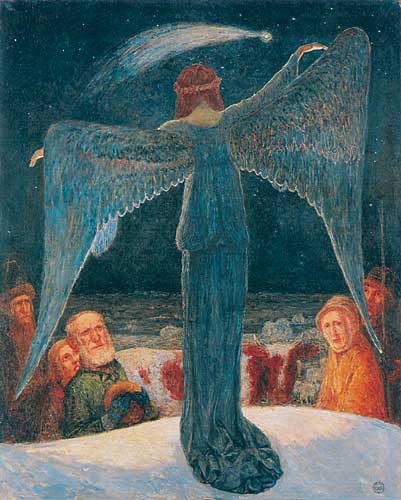
Annunciation to the Shepherds, 1902, Heinrich Vogeler
WRITTEN BY
Garrell Keesler