
FPC Civil Rights Pilgrimage
As they walked the Edmund Pettus Bridge in Selma, Alabama, the group followed a guide who had participated in the 1965 march. She had crossed this bridge then, when state troopers and local law enforcement waited on the other side. Now, decades later, she led a group from First Presbyterian up the gradual incline and recounted what had happened there.
The bridge rises gradually—the crest concealing what lies on the other side. For those who marched in 1965, that incline concealed what waited for them on the other side: state troopers, police dogs, billy clubs, and tear gas.
Ralph Greene tried to imagine it. “It’s so hard to describe. I couldn’t believe that group of people dared to do what they did—to see the opposition standing there, against and in front of them, and yet they still had the courage to make that effort.”
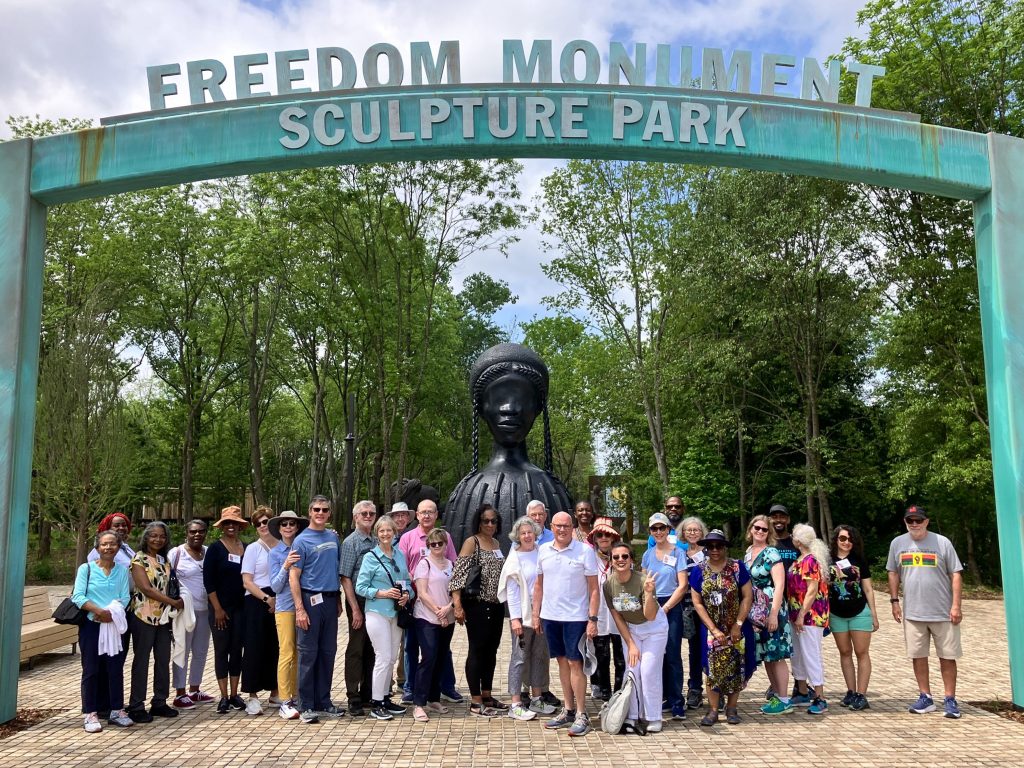
Last spring, members of First Presbyterian Church, along with teachers from Westerly Hills Academy, traveled through Alabama to trace the path of the Civil Rights Movement. Led by Rev. Lucy Crain and Civil Rights Advocate Larry Bosc, the four-day journey took participants to lynching sites and cemeteries in Georgia, the Legacy Museum and National Memorial for Peace and Justice in Montgomery, across the Edmund Pettus Bridge in Selma, and to Kelly Ingram Park and 16th Street Baptist Church in Birmingham.
What We Didn’t Realize
Many signed up simply wanting to learn. Others carried memories of the 1960s but sensed there was more to understand. Debbie Sidbury reflected, “Just having been an adolescent and young teen in the ’60s, it was just in my heart.”
Yet again and again, participants found themselves repeating a similar refrain: “I can’t believe what I didn’t realize.”
“It was interesting to share experiences,” Debbie said. “Most of us said we were appalled at what we did not realize was going on. You know, there were riots on TV; but I was still so unaware of anything but what I saw.”
On the bus between sites, they read and discussed Dr. Martin Luther King Jr.’s “Letter from Birmingham Jail.” One line lingered in their conversations: Justice too long delayed is justice denied. The words, written in 1963, felt anything but distant.
Sue Veres, who has served for more than 20 years as the transcriptionist for our television broadcast ministry, drove more than 3,000 miles to participate in the journey alongside a church family she has come to know so well through her work. “It’s essential to be a witness,” she explained.
Standing at memorials engraved with the names of victims, the history became painfully concrete. At the Civil Rights Memorial in Montgomery, each participant found the name of a martyr they had researched before the trip. Together, they placed their fingers on the engraved names and prayed.
Where is the Church?
Discovering the past led them to wonder how it shapes the present. During one bus discussion, participants wrestled with a question that continues to echo: Where is the Church in this?
The presence of two Westerly Hills Academy educators added depth to the journey. First Presbyterian has partnered with the school since 2000, walking alongside students, teachers, and families in Charlotte’s 28208 zip code. Through the Catherine S. Grier Community Building Initiative, teachers were invited to join the pilgrimage free of charge—an investment not only in individual growth but in shared learning.
For Kiarra Harris, one of the educators who joined the trip, the question is both personal and urgent. Raised in Long Island and the daughter of a pastor, she has long been drawn to African-American history. But she also brought her own lived experience into the conversation.
“I have the experience of racism, of prejudice, all the time,” she shared during a conversation on the bus, which surprised some fellow travelers who had not expected someone her age to say.
Conversations that began on the trip are already finding their way into Westerly Hills Academy classrooms.
“Our children do not know what to do,” Kiarra said, reflecting on the increasing removal of Black history from curricula. “They don’t understand the depth of—or the importance of—getting an education because they don’t know their history, because it’s not being taught to them.”
The trip also held unexpected moments of grace.
At the 16th Street Baptist Church in Birmingham—the site of the 1963 bombing that killed four little girls—Sue lingered after worship. As the congregation began to disperse, she extended her hand to a woman approaching her.
“I put my hand out, and I said, ‘Thank you for having us.’”
There was a long pause. Just as Sue was about to withdraw her hand, the woman reached out and shook it. “She put her hand out and shook my hand and said, ‘Thank you for coming.’”
Then the woman added, “I marched with Dr. King. I was arrested with him.”
Her name was Juanita Askew. She had been in high school when she was jailed just a few cells down from Dr. King as he wrote his famous letter.
Later, Sue learned from Juanita’s brother that she had not spoken to a white woman in decades.
It was a small moment. Silence. A handshake. A shared conversation. Yet it carried the weight of history and the hope of reconciliation.
“That’s what we do by learning about the victims of racial terror—we honor their lives,” she said.
The Conversations Continue
A guide on the trip told Sue something she cannot forget: “Once you know, you can’t unknow.”
The journey was heavy, and it changed them.
It changed how they see history, how they understand the present, and how they think about their role as followers of Christ.
The learning did not stay on the bus or at the museums. It came home to Charlotte—to worship, to committee meetings, to conversations, to classrooms at Westerly Hills. It deepened a partnership that has long been dear to First Presbyterian. It reminded participants that faith is not passive.
And so the conversations continue—not to argue or assign blame, but to bear witness. To plant seeds. To ask, as Kiarra urged, “OK, now we’ve educated you, you’ve seen it—what are we going to do? What are you going to do?”
This June, another group will make the journey. They will stand at memorials. They will cross the Bridge. They will wrestle with history, faith, and responsibility.
And they will likely discover what last year’s travelers did: once you know, you can’t unknow.
Registration is open for this year’s Civil Rights Trip. If you have ever wondered whether this trip is for you, consider this your invitation. Come listen, learn, and walk the ground where courage and conviction reshaped our nation. Learn more about the trip at fpc.tiny.us/civil-rights-trip, or visit firstpres-charlotte.org/advocacy to learn more about FPC’s racial justice endeavors.